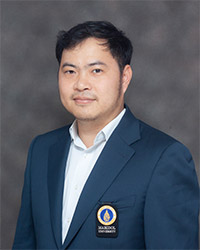
Songkhun Boonchaisuk
By changing nothing, nothing changes. (Tony Robbins)
About me
I am currently an Assistant Professor and Head of Geoscience Programs at Mahidol University, Kanchanaburi Campus, Thailand. I teach courses in Geophysics and Computer Programming. During my Master’s degree, I developed a forward modeling and inversion program for Direct Current (DC) Resistivity data by using MATLAB, resulting in a publication (Boonchaisuk et al., 2008). For my Ph.D., I led a survey team to study the crustal structure of Kanchanaburi Province using magnetotelluric and receiver function techniques, leading to Thailand’s first publication in this field (Boonchaisuk et al., 2013). My work involved installing seismic stations, data acquisition, data processing, and inversion, which marked the beginning of my interest in seismology.
After graduation, I contributed to the study of Thailand’s crustal properties and thickness using receiver function analysis (Noisagool et al., 2014). Following the largest earthquake in Thai history on May 5, 2014, I was involved in conducting a magnetotelluric survey and proposed a model related to the earthquake’s cause (Boonchaisuk et al., 2017).
Currently, our research group plans to apply a variety of geophysical techniques to better understand subsurface structures and active faults.
You can browse my publications, the courses I teach, the code I share, or my full CV.
Research interests
I am particularly interested in the application of machine learning to geophysics and geology. Although I am relatively new to machine learning, I have recently developed and taught an Introduction to Python course for our students. In the near future, I plan to expand this into a series of courses in computer simulation and Introduction to data science, aiming to establish a Data Science major for Geoscience students and other divisions at our campus.
News
- November 2026 — Published a visual summary of the two-day workshop Practical AI Agents with Hermes at Mahidol University (details).
- November 2026 — Released HeroForge, a turn-based fantasy strategy game in Python and pygame with hex-grid battles, towns and an AI opponent, all art and sound generated in code (source on GitHub).
- November 2026 — Released GeoCalculus Lab, 46 bilingual geoscience examples, quizzes and a course map for SCMA 111 Calculus, as an interactive app and Jupyter notebooks (on GitHub).
- November 2026 — Released Deep Time Kanchanaburi, a bilingual interactive page on 470 million years of Kanchanaburi geology (source on GitHub).
- October 2026 — Published the Thailand earthquake catalog 2014–2017 (2,238 relocated events and 87 moment-tensor solutions) as open CSV data on GitHub.
- October 2026 — Built Kanchanaburi GeoGuard, an AI geohazard watch and community-reporting system, for the MU AI Development Challenge 2026.
- October 2025 — New paper in Earth, Planets and Space: magnetotelluric insights into fluid-driven intraplate seismicity in northern Thailand, 1994–2024.
- September 2025 — Completed Introduction to GMT for Geophysics, a 20-hour EarthScope short course.
- August 2025 — Presented The Crustal Structure Study in Thailand at KIGAM, Daejeon, Korea.
- July–September 2025 — 90-day Scientist Invitation Program (SIP2025) at KIGAM, Korea, working on machine learning for geoscience.
- June–August 2025 — EarthScope Seismology Skill Building Workshop.
- February 2025 — Awarded Mahidol University Professional Standards Framework (MUPSF) Level 2.
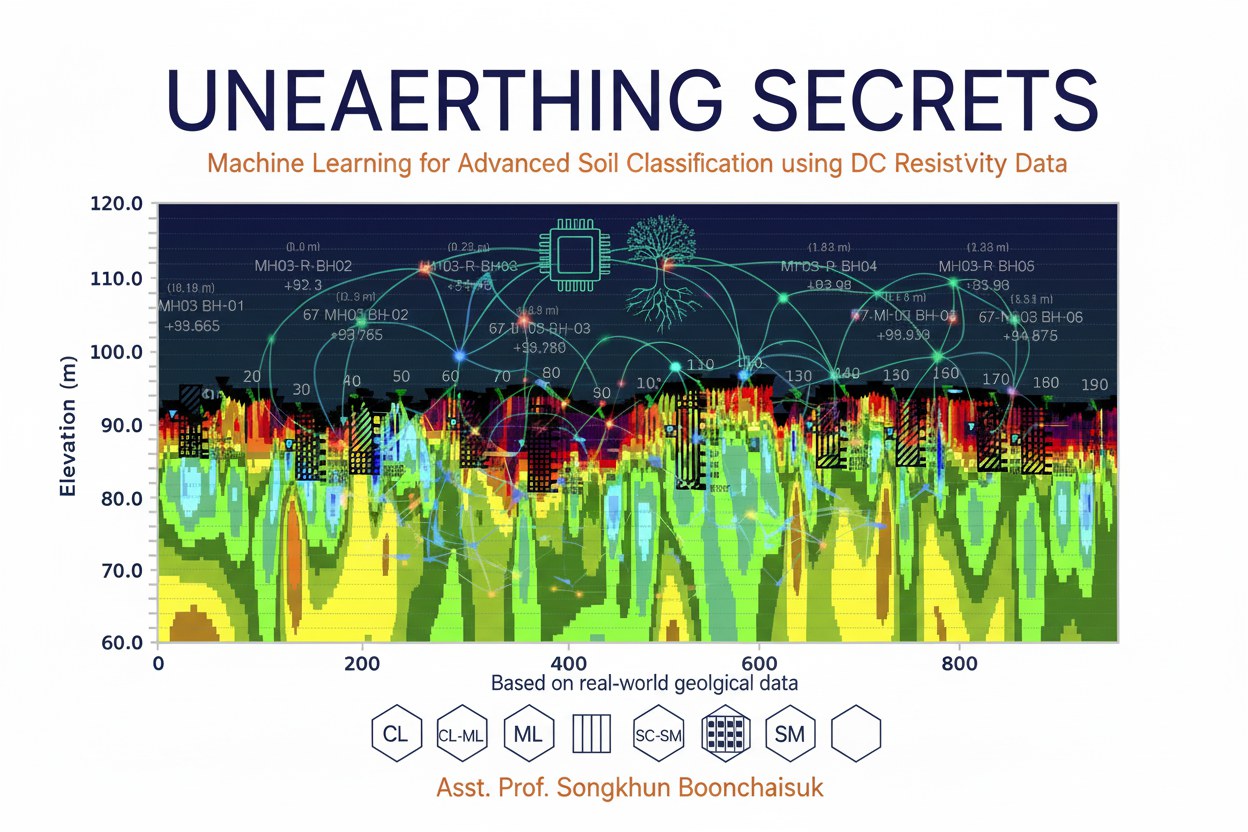 KIGAM 2025 — Scientist Invitation Program (SIP2025), Korea.
“If you don’t like something, change it. If you can’t change it, change your attitude.” (Maya Angelou)